
Picture this: You’ve just signed the lease on a “semi-furnished” apartment or closed the deal on your dream home. You unlock the door, expecting to see window treatments and appliances, only to find bare walls and empty alcoves. Panic sets in.
It’s a scenario that happens more often than you’d think. The term “furnishing” is surprisingly slippery. Does it include appliances? Are curtains considered fixtures or furnishings? If you sell your house, can you take the wall-mounted TV?
The confusion stems from the fact that “furnishing” means different things to a tax auditor, a landlord, and an interior designer. Misunderstanding these distinctions can lead to lost security deposits, legal disputes during property sales, or unexpected thousands spent on “basics” you thought were included.
This guide is your definitive answer. We will break down exactly what falls under the umbrella of furnishing, distinguishing between fixtures, fittings, and chattels, so you never have to guess again.
Table of Contents
- The Core Definition: What Counts as Furnishing?
- The “Shake Test”: Furnishings vs. Fixtures
- The Rental Spectrum: Unfurnished, Semi, & Fully Furnished
- Hard vs. Soft Furnishings: The Designer’s View
- Tax & Legal Implications
- Conclusion
The Core Definition: What Counts as Furnishing?
What is considered furnishing?
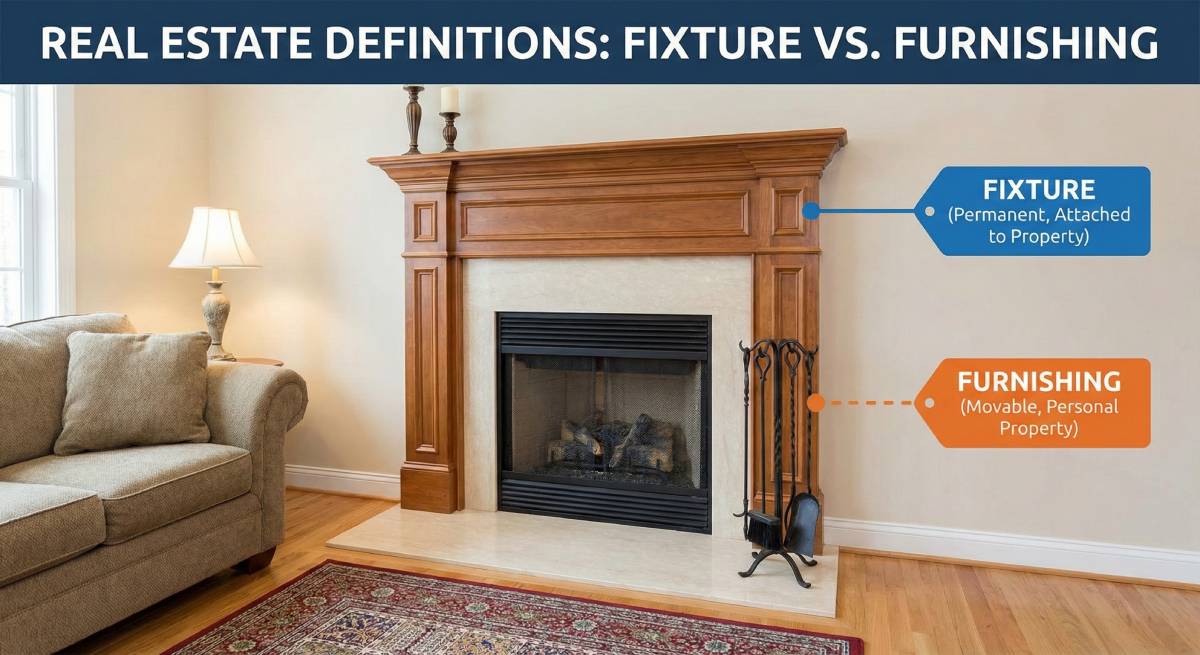
In the broadest sense, furnishings are defined as the movable objects intended to support various human activities such as seating (e.g., chairs, stools), sleeping (e.g., beds), and storage (e.g., cupboards, shelves). Unlike fixtures, furnishings are not permanently attached to the building structure and can be removed without causing damage to the property. This category includes furniture, appliances, rugs, and decorative accessories.
Quick Comparison: Furnishings vs. Fixtures
| Feature | Furnishings (Chattels) | Fixtures (Fittings) |
| Mobility | Easily Movable | Permanently Attached |
| Installation | Placed or Plugged in | Screwed, Glued, or Cemented |
| Legal Status | Personal Property | Part of the Real Estate |
| Examples | Sofa, Table, Rugs, Lamps | Built-in Cabinets, Sinks, Doors |
Warning: Before you rip out old built-in fixtures or wall panels during a renovation, ensure you aren’t disturbing hazardous materials. Always factor in potential asbestos removal costs if your property was built before 1990.
The “Shake Test”: Furnishings vs. Fixtures
When buying or selling a home, the line between what stays and what goes is often where deals fall apart. In legal terms, this is the battle between Chattels (furnishings) and Fixtures.
How to Tell the Difference
Real estate lawyers often use the “degree of annexation” test, but for the average homeowner, we prefer the “Shake Test.”
Pro Tip: The House Shake Theory
Imagine you could pick up the house, turn it upside down, and shake it.
- Everything that falls out is considered Furnishing (Chattel).
- Everything that stays attached is a Fixture.
Exception: Items that are screwed in but arguably removable (like a heavy wall-mounted mirror or TV bracket) exist in a “grey zone.” Always specify these in your contract!
Common Points of Confusion
- Curtains vs. Blinds: Curtain rods are usually fixtures (screwed in), but the fabric curtains are furnishings. However, custom-fitted blinds are often considered fixtures because they are cut to the specific window size.
- Light Fittings: A chandelier is a fixture. A floor lamp is a furnishing.
- White Goods: In the UK/Europe, kitchen appliances (fridge, washing machine) are often considered furnishings and taken by the seller. In the US/Canada, they are often considered fixtures and left behind.
The Rental Spectrum: Unfurnished, Semi, & Fully Furnished
If you are a tenant or a landlord, “furnishing” is less about physics and more about the inventory list. The definitions below are the industry standards, though they can vary slightly by region.
1. Unfurnished
Do not mistake “unfurnished” for “empty shell.” An unfurnished property must still be habitable.
- What is included:
- Flooring (carpets, hardwood, or tiles).
- Bathroom fixtures (toilet, sink, shower).
- Kitchen fixtures (sink, cabinetry).
- Sometimes: White goods (Cooker/Fridge) – Always check the lease.
- What you need to bring: Everything else. Beds, sofas, wardrobes, and often your own washing machine.
2. Semi-Furnished (Partly Furnished)
This is the most ambiguous category and the source of most tenant/landlord friction.
- What is usually included:
- All “Unfurnished” items.
- Major white goods (Fridge, Freezer, Washing Machine).
- Large items that are difficult to move (e.g., a wardrobe in a bedroom with no built-in storage).
- The Benefit: Offers a balance. You don’t need to buy heavy appliances, but you can still style the space with your own sofa and bed.
3. Fully Furnished
“Turnkey” properties are designed for professionals, students, or short-term stays.
- What is included:
- Living Room: Sofa, coffee table, TV stand, soft lighting.
- Bedroom: Bed frame, mattress, dresser/wardrobe, nightstands.
- Kitchen: White goods, microwave, toaster, kettle.
- Dining: Table and chairs.
- What might be missing: Bedding (sheets/duvets), towels, and kitchenware (pots/pans/cutlery) are often not included unless specified as “turnkey” or “serviced apartment.”
Expert Insight: The “Life Cycle” of Furnishings
Landlords, beware: The more you furnish, the faster your depreciation.
A fully furnished apartment attracts higher rent (often 15-20% more), but your maintenance costs skyrocket. You are responsible for repairing that toaster and replacing that stained mattress. We often recommend Semi-Furnished as the “sweet spot” for long-term rentals, as it attracts stable tenants who own their own furniture and stay longer.
Hard vs. Soft Furnishings: The Designer’s View
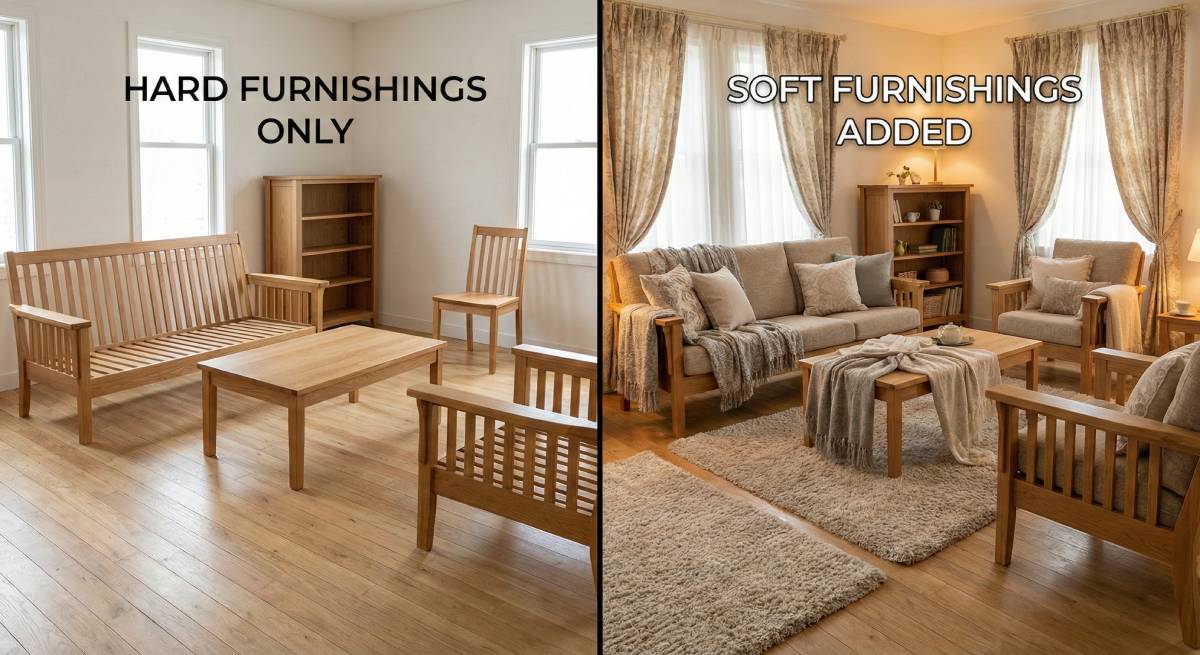
In the world of Interior Design, furnishing is split into two textures: Hard and Soft. This distinction is vital for budgeting renovations. As Alix Helps Interiors frequently advises clients, understanding this balance is key: while hard furnishings provide the function of a room, it is the soft furnishings that provide the feeling.
Hard Furnishings (Casegoods)
These are the functional bones of the room. They are usually made of wood, metal, glass, or plastic.
- Tables (Dining, Coffee, Side)
- Chairs and Benches
- Cabinets and Chests
- Bed Frames
Soft Furnishings
These add character, comfort, and acoustics to a room. They absorb sound and introduce color.
- Window Treatments: Curtains, drapes, blinds.
- Bedding: Duvets, pillows, throws.
- Upholstery: Fabric covering sofas and chairs.
- Rugs and Carpets.
- Cushions (Scatter pillows).
Tax & Legal Implications
Why does the definition matter legally? Money.
For Investors (Depreciation)
In many jurisdictions (like the US IRS or UK HMRC), Furnishings are depreciated differently than the Building itself.
- A building might depreciate over 27.5 or 39 years.
- Furnishings (carpets, appliances, furniture) often depreciate over 5 to 7 years.
- Strategy: Cost Segregation Studies often reclassify items from “Real Property” to “Personal Property” (Furnishings) to accelerate tax write-offs.
For Home Insurance
Your policy likely has separate coverage limits for “Dwelling” (Structure/Fixtures) and “Personal Property” (Furnishings).
- Scenario: A pipe bursts and ruins your hardwood floor (Fixture) and your Persian rug (Furnishing).
- Result: These claims may come out of two different “buckets” of your policy. Ensure your “Personal Property” limit is high enough to cover all your furnishings, not just the house itself.
Conclusion
“Furnishing” is not just a word; it is a contextual definition that changes depending on whether you are renting, selling, or designing.
If you remember only one thing from this guide, let it be the Shake Test. If it falls out when you shake the house, it’s a furnishing. If it stays put, it’s a fixture.
Your Next Step: Are you preparing a property for rental or sale? Don’t rely on verbal agreements. Create a detailed “Chattels Inventory” list today. Photograph every item you intend to leave (or take) and attach it to your lease or sales contract. It is the single best way to protect your deposit and your peace of mind.
